The Discovery Trap: A Map Isn't a Decision
Founders don't need more discovery — they need a decision. Here's why standard discovery engagements produce maps, not directions, and what to ask for instead.
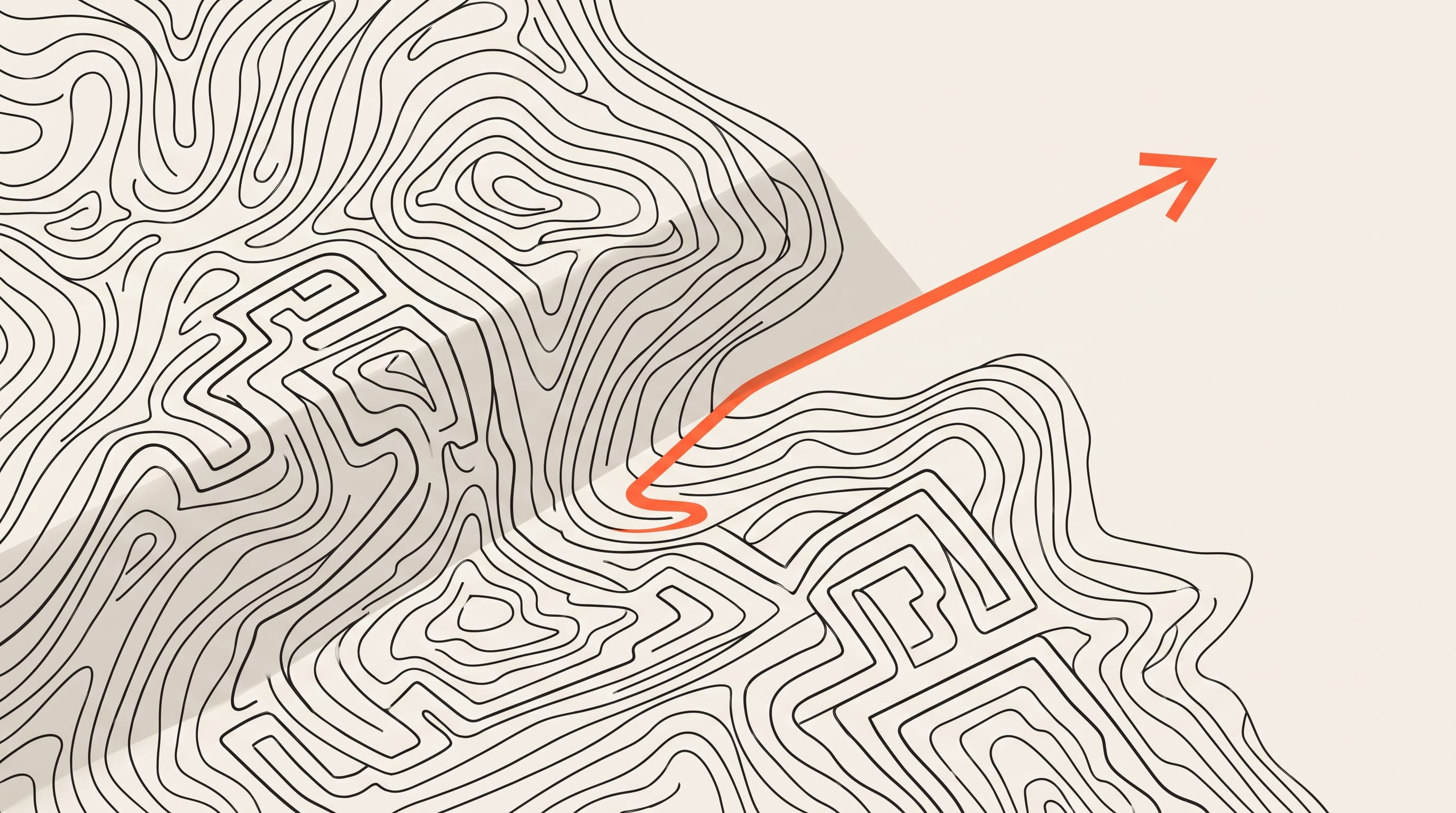
Why Discovery Produces a Map When You Need a Decision
Most founders who commission a discovery engagement get roughly the same thing back: a current-state map, a set of user research findings, and a shortlist of possible directions. It's thorough. It's well presented. It's usually accurate.
And it usually doesn't tell you what to build.
This isn't a failure of effort. It's a failure of design. The engagement was built to produce documentation, and documentation is what it produced. The founder is better informed and no less stuck — which is a strange place to be after spending real money and real runway on clarity.
The line I hear is some version of: "We've got the research. We still don't know what we're doing on Monday." What they bring is often a polished deck, several journey maps and a long list of sensible opportunities. What is missing is the part nobody wanted to be responsible for: which problem comes first, what is deliberately left out, and what the business can realistically support. They do not usually need another workshop. They need someone to turn the evidence into a decision and stand behind it.
What the Research Actually Confirms About Founder Constraints
Until recently this was a practitioner's complaint, not an evidenced one. That changed in 2026. A study of 171 product professionals across 37 countries, presented at the 9th ACM/IEEE International Workshop on Software-intensive Business, found that founders average roughly 15 hours a week for the entirety of product management — strategy, discovery, prioritisation, delivery oversight, all of it. Within that scarcity, it's the upstream activities — strategic formulation, structured discovery, long-horizon planning — that get dropped first, in favour of near-term execution. That isn't a discipline failure; it's what happens to planning work when the hours simply aren't there.
The implication for discovery is direct: a founder cannot sustain an open-ended research phase, and shouldn't be sold one. Whatever discovery process a founder commissions has to itself deliver time to value — a decision, a scope, a path to delivery — or it is consuming the very resource it was meant to protect.
The Structural Flaw: When Strategy, Design, and Technical Direction Are Separated
The Nielsen Norman Group's widely cited definition of discovery sets out what a well-run discovery is meant to achieve: a proposed solution that is simultaneously desirable to users, viable for the business, and feasible to build. Three concerns, held at once, resolved together.
In practice, they're rarely held together. A 2020 IEEE review of product discovery practice found that discovery is intended to address exactly these risks — value, usability, feasibility and business viability — before implementation starts, but that a persistent pitfall is discovery work that generates artefacts without generating an actionable decision. The review is a grey-literature synthesis precisely because rigorous academic guidance on how to run discovery well is thin. Practitioners are largely on their own.
What happens in most commissioned discovery work is a quiet separation of labour. A strategist or researcher handles desirability and, loosely, viability. Technical feasibility is deferred — parked for "the build phase," handed to an engineering team that hasn't been in the room, or reduced to a generic feasibility slide near the end of the deck. The three concerns the NN/g definition insists must be resolved together are instead resolved in sequence, by different people, at different times.
This is the structural flaw. It isn't that the research is bad. It's that the engagement was never designed to converge on a decision, because the one variable most likely to force convergence — what this can actually cost to build, operate, and maintain, with this team, in this timeframe — was never part of the conversation.
The Moment the Decision Becomes Clear
In my own practice, the moment a strategic option stops being one of several plausible directions and becomes the direction is very rarely a research finding. It's a constraint.
A user interview might reveal that two directions are both desirable. A viability review might show both are commercially sound. What resolves the disagreement — what actually makes the decision make itself — is almost always the technical shape underneath: what the existing system can support without a rebuild, what a small team can operate without a specialist hire, what the infrastructure costs look like at the volumes the business actually expects to hit.
The direction usually becomes clear when we stop discussing an abstract journey and follow one real piece of work all the way through. On an operational product, that might mean tracing an order from first enquiry through office planning, warehouse and field delivery. On a content platform, it might mean following one page from a search result through migration, identification and a returning user. A decision appears where three things meet: what the user needs, how the organisation actually works, and what the team can keep running. Once those are visible together, several attractive options normally fall away.
That moment can't be manufactured by a researcher who doesn't hold technical direction, or by an architect who wasn't in the strategy conversation. It requires one person — or one small, tightly integrated team — carrying strategy, design, and technical judgement through the same sessions, so that when the constraint appears, it's recognised immediately for what it is: the answer.
That principle shaped one of the operational platforms in my portfolio. The business had specialist tools, spreadsheets and manual handovers across the service journey. On the surface, it looked like a series of departmental interface problems. Following the work from office planning to warehouse and field delivery exposed the real constraint: each context needed a different interface, but every team needed to act on the same underlying information. That changed the decision. The question stopped being "Which team's screen should we rebuild first?" and became "What must be reliable before any of those screens can work?" The shared operational model came first; the views followed. Read the public case study.
What a Decision-Led Discovery Actually Looks Like
This doesn't mean skipping research or locking in technical decisions prematurely. Premature specification is a real risk, and separating strategy from technical direction is sometimes a deliberate, reasonable safeguard against it — particularly in larger organisations with stable engineering teams who can absorb ambiguity for longer.
But there's a difference between refusing to decide too early and refusing to engage with technical shape until strategy feels settled. The latter is deferral dressed up as rigour, and it's what founder-stage discovery can't afford.
In the first week, I want to see the work rather than hear a polished version of the brief. I speak to the people doing it, follow the important jobs and information through the tools they already use, and note where context gets lost or rules live only in somebody's head. Then I sketch or prototype the riskiest part early enough for it to challenge the strategy. I am happy to defer colour, polish and secondary features. I will not defer the core interaction, the data boundaries, migration or integration realities, or the question of who decides when the system is uncertain. Those are not details for later. They determine whether the idea is viable.
Done well, a founder-stage discovery engagement should produce three things, not one: a decision about direction, a credible scope for what happens next, and a rough but honest sense of cost and delivery shape. If it produces a map and a list of options instead, it has produced theatre — a well-executed performance of due diligence that leaves the actual decision exactly where it found it.
How to Tell Whether You Need More Research or a Different Engagement
The test is simple, if uncomfortable. Look at what you already have. Ask whether the gap is a missing fact or a missing decision.
If you genuinely don't know something material — whether a segment of users actually has the problem you think they have, whether a channel exists to reach them — that's a research gap, and more discovery is the right tool.
If you know roughly what users want, roughly what the market looks like, and roughly what's technically possible, but you still can't tell your team or your board what you're building — that isn't a research gap. That's a decision you, or your previous engagement, have been avoiding. No further research will resolve it, because research was never the constraint.
AI-assisted execution makes this problem more visible, not less: if delivery becomes faster while the direction remains unresolved, the team simply reaches the wrong place sooner.
The Brief: What to Ask For Instead
If you're deciding whether to commission another round of research or find a different kind of engagement, change the brief, not just the provider.
Ask for a decision, a scope, and a cost envelope — explicitly, as deliverables, not as things that might emerge if the research goes well. Ask who on the engagement is responsible for technical feasibility, and confirm they're in every strategic conversation, not consulted afterwards. Ask what happens if, three weeks in, the technical picture contradicts the early strategic preference — if the answer is "we'd flag that for a later phase," you're buying a map again.
A single senior practitioner holding strategy, design, and technical direction at once won't scale to a large product organisation, and it isn't meant to. But at the stage where the real question is what to build, that concentration of judgement is precisely what a founder needs — and handing the problem to a larger team before the direction is set is one of the more expensive mistakes available. Product strategy work at this stage should be judged on one thing: whether it leaves you able to say, specifically, what you're building next — not on how comprehensive the map looks.

Written by Nathan Cope
Independent product designer and engineer. I write from active work across complex products, dependable AI, commerce and connected systems.
About the practice